
[Prime Economy] Chokwang Paint (CEO Yang Seong-a, 004910) has unveiled the results of one year of open innovation centered on proof of concept (PoC). Throughout the event, the company clearly demonstrated its determination to move beyond the image of a paint manufacturer and expand its scope into materials, ESG, safety, and digital transformation.
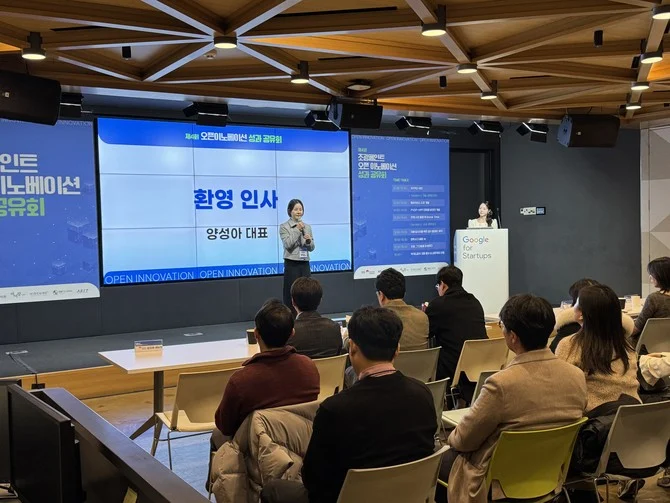
Yang Seong-a, CEO of Chokwang Paint, is presenting the company’s open innovation achievements. = Reporter Kim Woo-ram
On the 4th, Chokwang Paint held the Chokwang Paint Open Innovation Results Sharing Session at the Google for Startups Campus in Gangnam, Seoul. The event was attended by Chokwang Paint CEO Yang Seong-a, partner companies, and representatives from local governments and support organizations, who shared the results of the PoC projects carried out last year as well as future strategies.
Ahead of the event, CEO Yang Seong-a said, “It has now been four years since Chokwang Paint officially began open innovation,” adding, “Open innovation has been a period of experimenting with and validating new technologies.”
She continued, “We now have a much clearer sense of which technologies and partners we should move forward with,” and emphasized that “continued interest and bold challenges are what enable us to discover new market opportunities.”
She also stated, “Please keep an eye on how the efforts of the companies presenting today will change the industry,” adding, “Chokwang Paint will also connect the outcomes generated in the field to its actual business and ESG activities.”
In the first session, titled “Seeking Out Technology,” PoC cases centered on materials were introduced.
Yoon Kyung-ho, Senior Manager of Chokwang Paint’s New Business Office, first explained the background of the collaboration with VisCure. He pointed out that “the key word for VisCure is ‘light,’” and went on to explain, “The company possesses a core technology that enables curing using visible light rather than ultraviolet light, and we believed it was a technology capable of achieving both eco-friendliness and safety.”
The two companies initially conducted a PoC on a transparent adhesive for displays. The idea was to verify a material for next-generation display processes using a visible-light-curable adhesive. However, as discussions continued, the direction of the collaboration changed.

이석주 비즈큐어 대표가 조광페인트와의 오픈이노베이션을 통해 지속적인 항균 효과와 시공 편의성을 모두 고려한 솔루션을 목표로 한다고 밝혔다. = 김우람 기자
Yoon explained, “We believed that combining VisCure’s visible-light curing technology with Chokwang Paint’s antiviral coating technology would open up a larger market.” As a result, the companies boldly discontinued the original adhesive PoC and shifted to a new PoC focused on antiviral coatings.
Seokju Lee, CEO of VisCure, said, “Most conventional polymer synthesis methods rely on heat or ultraviolet light. While these methods are convenient for producing polymers, high-temperature processes and ultraviolet light place a burden on both the environment and human health.”
VisCure has developed a polymer synthesis system that combines a photocatalyst absorbing in the visible-light range with a specialized initiator.
Based on this technology, the company has developed a UV-blocking transparent adhesive for displays. Compared with conventional commercial adhesives, it offers superior UV-blocking performance while maintaining visible-light transmittance. The technology is currently undergoing validation with companies including LG Display.
The antiviral coating PoC being carried out jointly by Chokwang Paint and VisCure has already demonstrated meaningful antibacterial and antiviral effects in the first round of testing. Application scenarios are being discussed for contact surfaces in public spaces, such as walls, doors, and handles in hospitals, post offices, and banks. Lee said, “We aim to provide a solution that takes into account both sustained antimicrobial performance and ease of application.”
Also introduced in the same session was Chokwang Paint’s collaboration with ASET, which is directly related to secondary battery safety. A company representative said, “We came together with ASET around two key themes: safety and technological leadership.” Amid ongoing concerns over fires involving electric vehicles and energy storage systems (ESS), the two companies have been pursuing a project to jointly develop a binder and co-solvent for all-solid-state electrolytes.
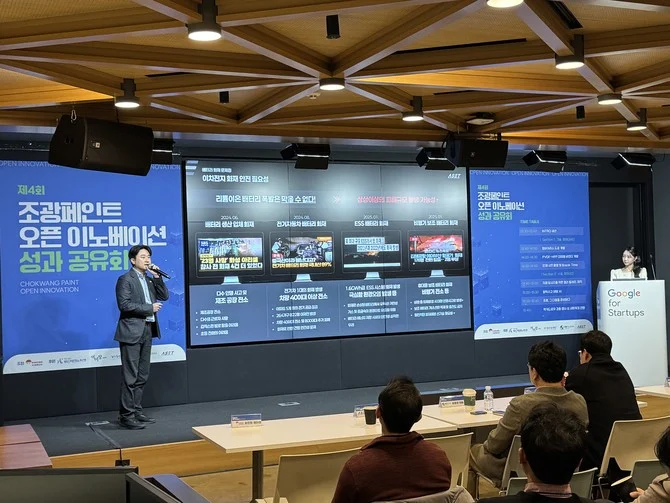
Park Seok-jeong, CEO of ASET, is working to prevent battery explosions through open innovation. = Reporter Kim Woo-ram
Park Seok-jeong, CEO of ASET, first explained the mechanism by which lithium-ion batteries explode. He said, “As charging and discharging are repeated, some lithium turns into metallic form and dendrites begin to grow,” adding, “When these metallic needle-like structures pierce the conventional separator, they can cause an internal short circuit and thermal runaway.”
ASET has adopted a strategy of replacing the separator with a ceramic-polymer composite solid-state electrolyte membrane. Park said, “If batteries use the membrane we are developing, even end-of-life batteries can achieve significantly improved protection against internal short circuits,” adding, “Our goal is a battery that may reach the end of its lifespan, but does not explode.”
He also said, “Next year, we plan to develop a new binder formulation based on a new co-solvent and move forward with pilot-scale production.” Chokwang Paint added, “Through our collaboration with ASET in the battery materials business, we aim to prepare for the era of all-solid-state batteries.”
The second session, titled “Demand Comes Knocking,” introduced projects that combine social value with color expertise.
Lee Su-jeon, a team leader at Chokwang Paint, explained, “Under the slogan ‘Chokwang Fulfilling Its Responsibility to the Planet,’ Chokwang Paint has been carrying out a variety of social contribution activities. While considering projects that could make use of Chokwang Paint’s color expertise rather than simple donations, we came across Ieijang, an organization that researches dementia-friendly spaces.”
Chokwang Paint’s Architectural Color Team is an organization that analyzes the effects of color on people and proposes exterior and interior color schemes for buildings. Recently, the team has also expanded its interest into Color Universal Design (CUD) for socially vulnerable groups such as older adults and people with color vision deficiencies.
Lee said, “As the pace of population aging accelerates, color design that helps elderly people with dementia live more safely and comfortably has become increasingly important. The reason we pursued this PoC was our belief that color can make living environments even slightly more user-friendly.”
Chokwang Paint, Ieijang, and the Korea Color Universal Design Association formed a joint advisory group and developed six color palettes for people living with dementia. In narrowing down the candidate colors, they also conducted surveys of elderly people with dementia, including preference and aversion assessments and color cognition tests.
Lee Hye-sook, CEO of Ieijang, said, “The real goal of this project is to help elderly people with dementia continue their daily lives within the community without being socially isolated.”
She also referred to a case in the UK, saying, “I was deeply inspired by seeing dementia-friendly gardens and color design at a garden exhibition in the UK. I saw firsthand how color can reduce anxiety in elderly people with dementia and help them better recognize space.”
In this project, the concept of Light Reflectance Value (LRV) served as a key standard. LRV is a numerical measure of how much visible light a color reflects. Lee explained, “There needs to be at least a 30-point difference in LRV between adjacent surfaces such as floors, walls, and doors so that elderly people with dementia can more easily recognize boundaries and direction, which also helps reduce the risk of falls.”
The demonstration sites included the rooftop garden, indoor “Nanumteo” lounge, and basement outdoor yard of the Busan Dolbom building in Yeonje-gu, Busan. The rooftop garden used green, orange, and pink tones reminiscent of spring and autumn, reflecting the seasonal colors of planted vegetation. In the indoor Nanumteo space connected to the garden, color was strategically concentrated on walls containing hazardous elements such as the entrance door to the electrical room, so as not to draw unnecessary attention elsewhere.
In the basement outdoor yard, considering the limited sunlight in the space, highly contrasting colors in terms of LRV were applied around stair edges, level differences, and tank facilities. The goal was to make movement paths easier to recognize even in a dark environment.
Lee said, “Dementia-friendly color design is still in its early stages.” She added, “We plan to share this case with domestic and international academic societies and dementia care facilities, and develop it further into color guidelines for dementia-friendly spaces.”
The final presentation introduced a PoC case combining chemical safety and artificial intelligence. A Chokwang Paint representative said, “Large-scale chemical accidents have continued to occur, such as the Samsung hydrofluoric acid leak and the more recent chemical accident in Eumseong, North Chungcheong Province. As a manufacturer that also handles a variety of chemical substances, Chokwang Paint concluded that what is needed is not just post-accident response, but a system for advance prediction and prevention.”
Anfeelgrim is a company that develops chemical accident prediction and chemical substance data automation solutions. Its CEO, Kim Ho-hyun, is both a university professor and entrepreneur. He is also an expert who has conducted risk assessment and risk communication projects with institutions such as the National Institute of Chemical Safety and the Korea Environment Corporation.
Kim said, “Chemical accidents may not feel like a major issue in everyday life, but once they occur, they can threaten a company’s very existence. Because Chokwang Paint has not experienced a major accident, this is actually the time when it has the room to prepare. It is the best time to accumulate data and build prediction models.”
The PoC was carried out along two tracks. The first was a platform for predicting the possible spread of chemical accidents based on plant weather information and process data. Kim explained, “We are training Chokwang Paint’s data using three prediction models developed through national R&D projects.” These models incorporate meteorological factors such as wind direction, wind speed, temperature, and humidity, as well as conditions related to storage tanks and pipelines.
He said, “Compared with conventional commercial programs, this system provides more detailed site-specific risk analysis and wind-rose-based dispersion simulations.” In December, a first demonstration was conducted at Chokwang Paint’s Eumseong plant. At that time, a test was performed using actual weather data to observe changes in the affected radius under hypothetical accident scenarios.
The second track involved a system for automatically extracting key information from the MSDS (Material Safety Data Sheets) of raw materials and products. Since Chokwang Paint produces thousands of raw materials and numerous products, MSDS management requires a considerable amount of manpower and time.
Kim said, “We conducted experiments using artificial intelligence to automatically extract regulatory information, hazard details, and handling precautions from MSDS documents in various formats.”
He added, “The extraction success rate was high for raw material MSDS documents, but for finished product MSDS documents, the failure rate was higher due to variations in format and document quality. Even so, the results alone can be used to assess the MSDS management standards of suppliers.”
At present, the automatic extraction success rate stands at over 70%. Anfeelgrim aims to improve this to the mid-80% range through further algorithm enhancement. A second demonstration is planned for next January.
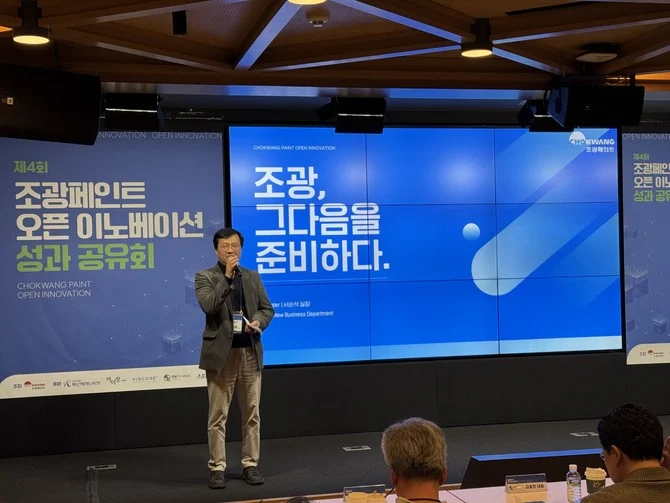
Seo Soon-seok, Head of Chokwang Paint’s New Business Office, also presented the future direction of the company’s open innovation efforts. = Reporter Kim Woo-ram
Through this event, Chokwang Paint also presented the future direction of its open innovation efforts. Seo Soon-seok, Head of the New Business Office, said, “Up to now, our New Business Office has mainly identified promising companies and proposed them to internal departments. Going forward, however, we will shift to a demand-driven structure in which business units first define their problems and challenges, and then seek out partners that fit those needs.”
He also noted the limitations of the domestic collaboration pool in the materials sector. Seo said, “There are still not many domestic partners with globally competitive technologies in certain materials fields,” adding, “We will also pursue PoCs with overseas companies in the United States, Japan, and elsewhere to bring in new technologies more quickly.”
He also outlined plans for regional collaboration. “Regional technoparks and innovation institutions in areas including Busan, Daegu, Ulsan, Sejong, Gwangju, Jeollanam-do, and Chungcheongnam-do are actively engaged in open innovation,” he said. “We will strengthen a structure in which region-specific projects are identified, and Chokwang Paint serves as a regional hub partner.”
김우람 기자 | kwr@newsprime.co.kr | 2025.12.04 16:39:51


