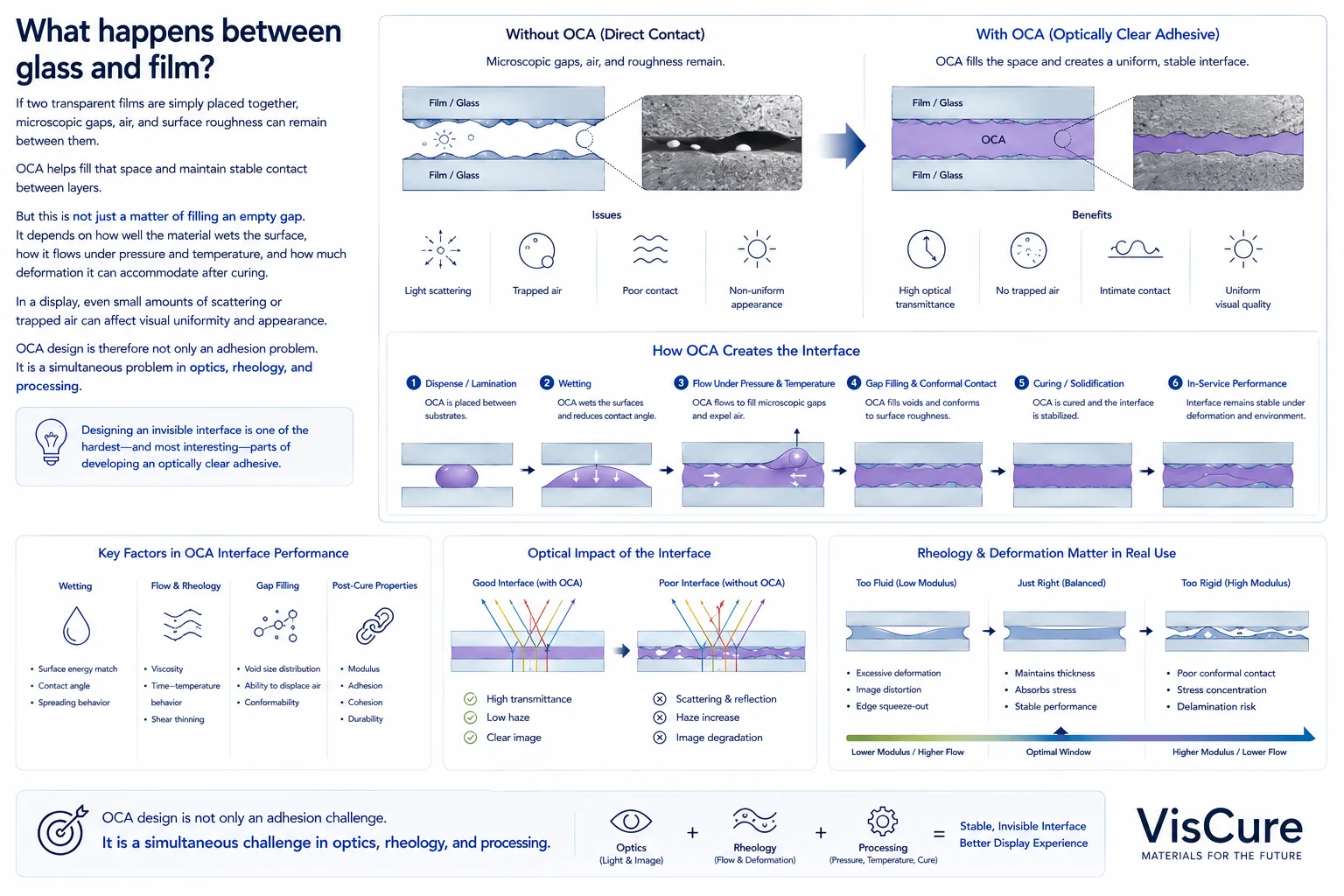
If two transparent films are simply placed together, microscopic gaps, air, and surface roughness can remain between them.
OCA helps fill that space and maintain stable contact between layers. But this is not just a matter of filling an empty gap. It depends on how well the material wets the surface, how it flows under pressure and temperature, and how much deformation it can accommodate after curing.
In a display, even small amounts of scattering or trapped air can affect visual uniformity and appearance.
OCA design is therefore not only an adhesion problem. It is a simultaneous problem in optics, rheology, and processing.
Designing an invisible interface is one of the hardest—and most interesting—parts of developing an optically clear adhesive.