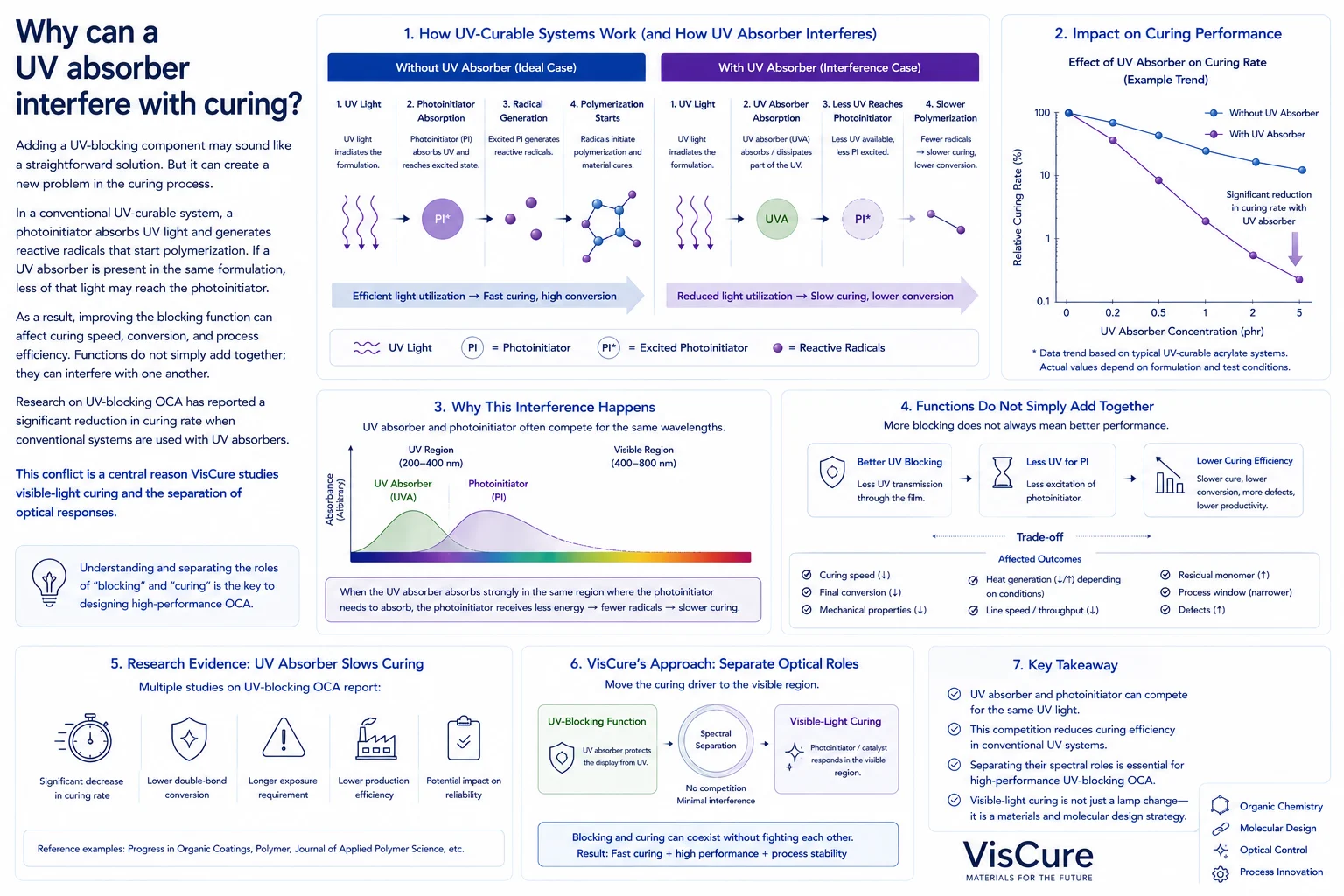
Adding a UV-blocking component may sound like a straightforward solution. But it can create a new problem in the curing process.
In a conventional UV-curable system, a photoinitiator absorbs UV light and generates reactive radicals that start polymerization. If a UV absorber is present in the same formulation, less of that light may reach the photoinitiator.
As a result, improving the blocking function can affect curing speed, conversion, and process efficiency. Functions do not simply add together; they can interfere with one another.
Research on UV-blocking OCA has reported a significant reduction in curing rate when conventional systems are used with UV absorbers.
This conflict is a central reason VisCure studies visible-light curing and the separation of optical responses.